
NEW! AutoCalc allows you to automatically calculate your material needs for complete soundproofing of your room 👉 Read more
🛠 Application and coverage
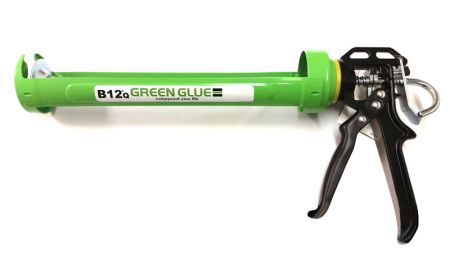
NB! Remember to order an applicator gun (accessory) – Green Glue tubes are larger than standard and don’t fit in standard grouting syringes.
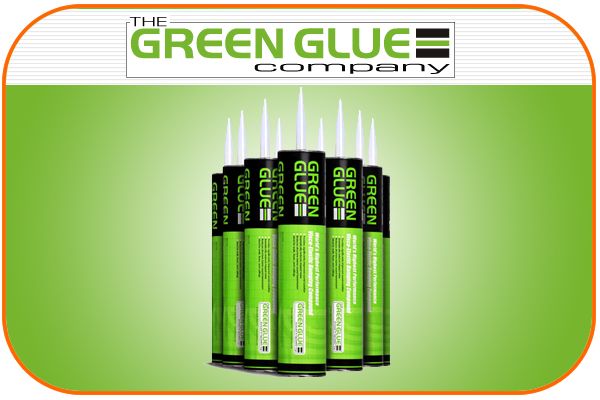
Each tube contains 28 oz (approx. 0.83 liters) of damping compound – far larger than standard sealant tubes.
At the recommended usage (2 tubes per plasterboard of 1.2 x 2.4 meters), this corresponds to approximately 0.6 tubes per m².
For example, if you want to cover a 15 m² wall, you need 15 × 0.6 = 9 tubes.
📄 Datasheets and reports
- UL Flame and Smoke Generation – Green Glue (2016)
- CARB 310 VOC Emission – Green Glue Sealant
- BPD3 Green Glue
- Green Glue LEED report v2.0
ℹ️ Product information (manufacturer text)
Green Glue is a water-based, viscoelastic damping compound that delivers extremely high performance. It is cost-effective, easy to use and far more tolerant of practical installation conditions than many other systems.
- Non-toxic
- No mixing required
- Apply with a sealant sprayer
- Low application cost
- Lightweight material – less strain on the user
🧱 Walls and ceilings
- Improved sound insulation
- Especially good in the low frequency range
- Laboratory tested
- Eliminates the risk of electrical short circuits in soundbar walls
- Maximum performance when used with a double stud wall
- Reduces structure-borne sound
- High performance at low cost
🏠 Floor
- Reduced step sound
- Better airborne sound insulation
- More affordable than most floor treatments
- Reduces structure-borne sound
🎵 Other applications
- Effective in technical rooms, elevator shafts, stages, etc.
- DIY and OEM speakers – up to 20x higher damping than MDF alone
📊 STC/Rw improvements with Green Glue
Green Glue is a viscoelastic damping compound that is applied between two layers of plaster or other rigid material. This reduces vibrations and significantly improves sound insulation. According to test data from TMSoundproofing, Green Glue provides the following improvements:
-
Standard wooden stud wall (2×4, 16″ OC, 2 layers of 5/8″ plaster):
-
Without Green Glue: STC 40
-
With Green Glue on one side: STC 52 (~75% improvement)
-
With Green Glue on both sides: STC 55 (over 80% improvement)
-
-
Staggered stud wall:
-
Without Green Glue: STC 50
-
With Green Glue on one side: STC 58 (~65% improvement)
-
With Green Glue on both sides: STC 62 (~75% improvement)
-
-
Double stud wall:
-
Without Green Glue: STC 61
-
With Green Glue on one side: STC 69 (~65% improvement)
-
With Green Glue on both sides: STC 73 (over 75% improvement)
-
These figures show that Green Glue can improve the STC value by up to 10-13 points, which corresponds to a significant reduction in sound transmission.
📉 Low-frequency performance
Green Glue is particularly effective in the low frequency range (below 125 Hz), where traditional STC measurements often fail to capture improvements. Test data shows that Green Glue can reduce low-frequency sound by up to 12 dB compared to identical wall constructions without Green Glue.
🏠 Floor and ceiling applications
In floor and ceiling constructions, Green Glue can also improve sound insulation.
-
Floor: Reduction of impact sound by an average of 8.5 dB, improvement of IIC by 7 points and STC by 6 points.
-
Roof structures: Significant reduction of structure-borne sound and improved airborne sound insulation.
📈 Comparison graphs
For visual comparisons of sound insulation with and without Green Glue, we refer to the following resources.
These resources contain graphs and detailed test results that illustrate the effect of Green Glue in different constructions.
🔍 Important considerations
-
STC limitations: Standard STC measurements cover frequencies from 125 Hz and above. For low-frequency noise (e.g. bass sounds) it is important to consider additional measures such as decoupling, preferably our highly effective DreamScreen ProSilence clips.
-
Cost vs. performance: Although Green Glue may be more expensive than adding an extra layer of drywall, it offers better performance, especially in the low-frequency range, and may be more cost-effective when space savings and installation costs are taken into account.
-
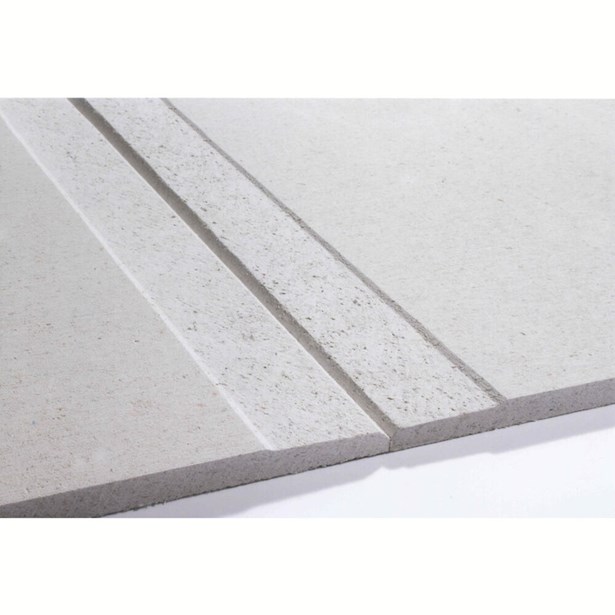
Installation: For optimum performance, Green Glue should be applied between two rigid layers (e.g. fiber plasterboard) and not used as an adhesive or sealant. It is important to follow the manufacturer’s instructions carefully.


Reviews
There are no reviews yet.